
He had been sick for two years. Joint pain that moved from one location to another. Fatigue so severe that getting through a workday required two naps. Cognitive fog that made a formerly sharp mind feel underwater. He saw a rheumatologist, a neurologist, and an infectious disease specialist. Each ran their own tests. Each came back negative.
The infectious disease specialist tested him for Lyme disease. The test was negative. That was the end of the Lyme conversation, even though he had been working outdoors in the Northeast for 15 years.
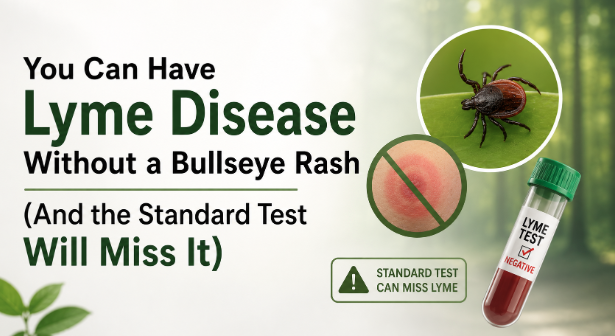
What nobody told him was that the test he received misses Lyme disease in a significant percentage of people who actually have it, and that the standard protocol does not include the more accurate testing that exists.
Why the Standard Tests Fail
Lyme disease is caused by Borrelia burgdorferi, a spiral-shaped bacterium transmitted through tick bites. The standard medical approach to testing involves two steps: an ELISA (enzyme-linked immunosorbent assay) followed, if positive, by a Western blot confirmation test. This two-step protocol is what essentially every conventional physician orders
The problem is that both tests measure antibodies, not the bacteria itself. They look for the immune system’s response to Borrelia rather than detecting Borrelia directly. And Borrelia has evolved a remarkable ability to evade the immune system.
Borrelia wraps itself in a protein coating derived from the host’s own cells. This effectively disguises the bacterium as “self” tissue, making it invisible to much of the immune response. The result is that in many infected individuals, the immune system never mounts a strong enough antibody response for the ELISA or Western blot to detect. The test returns negative not because Borrelia is absent, but because it is hiding well enough that the immune system’s markers are below the detection threshold.
This is a structural flaw in the testing approach, not a rare exception. Providers who specialize in tick-borne illness see negative ELISA and Western blot results regularly in patients who have clinical presentations strongly consistent with Lyme disease.
The Rash Is the Exception, Not the Rule
The bullseye rash, known medically as erythema migrans, is highly specific to Lyme disease when it appears. The problem is that it appears in only a portion of Lyme cases, and the estimate of how often varies significantly depending on the study. Many Lyme-infected patients never develop a visible rash at all. Others develop a rash that does not look like the classic bullseye pattern, a simple expanding red lesion without the concentric rings, which may not be recognized.
Tick identification adds another complication. Lyme disease is most commonly transmitted by nymph-stage ticks, which are approximately the size of a ballpoint pen dot. They are nearly invisible on a visual skin check. Many people who acquire Lyme disease never find or see the tick that bit them. The absence of a known tick bite is not evidence against Lyme infection.
The Testing That Actually Works
FISH testing, fluorescence in-situ hybridization, is a direct detection method. Rather than looking for antibodies, it identifies Borrelia DNA and RNA directly from a blood sample. This removes the evasion problem: Borrelia can hide from the immune system, but its genetic material cannot hide from a molecular test.
FISH testing is significantly more expensive than standard antibody testing and is not covered by most insurance plans. This is, in practical terms, the reason it is not routinely used. Cost drives protocol, not clinical accuracy. For a patient who can afford to pay out of pocket, or who has been sick enough for long enough, the test provides information that the standard protocol simply cannot.
Other specialized tick-borne illness panels, available through labs that specialize in infectious disease, test for co-infections simultaneously. This matters enormously.
Co-Infections Are Often the Worse Problem
A tick that carries Borrelia frequently carries other pathogens as well. The most clinically significant co-infections are Bartonella and Babesia.
Bartonella produces a constellation of symptoms including psychiatric manifestations, severe neurological effects, foot pain, skin striations, and rage episodes that look nothing like classic Lyme. Patients with prominent Bartonella co-infection may not look like typical Lyme patients at all, which is one reason providers who do not specialize in tick-borne illness frequently miss it entirely.
Babesia is a parasite. This distinction is critically important because antibiotics, the treatment used for bacterial infections including Borrelia and Bartonella, do not work against parasites. A person being treated for Lyme disease who also has Babesia may respond partially to antibiotics but will not recover fully because half of the infection is not being addressed. Babesia requires anti-parasitic medications, and it requires knowing to look for it, which does not happen in standard Lyme workups.
Providers who specialize in tick-borne illness, including those who are members of ILADS (the International Lyme and Associated Diseases Society), are trained to test for and treat the full spectrum of co-infections simultaneously.
Botanical Antimicrobials and Treatment Complexity
Treatment for Lyme disease and its co-infections is not simple, and recovery is not fast. This is one of the most important things to understand upfront, because patients who expect a two-week antibiotic course to resolve years of infection are setting themselves up for disappointment and potentially giving up on treatment before it has had time to work.
Borrelia has a complex life cycle. The standard bacterial form, called the spirochete, is susceptible to certain antibiotics. But Borrelia also forms biofilms, protective communities of bacteria encased in a polysaccharide matrix that antibiotics cannot penetrate effectively. It can also shift into a dormant cyst form that waits out antibiotic treatment and reactivates afterward.
This is why treatment often combines different agents targeting different forms of the bacteria, rotated to prevent adaptation. Botanical antimicrobials, plant-derived compounds with antimicrobial properties, have shown in some research to outperform pharmaceutical antibiotics against biofilm-form Borrelia. This is not a fringe claim. It is supported by laboratory research, and clinicians who treat Lyme regularly incorporate both pharmaceutical and botanical protocols.
Recovery is measured in months to years, not weeks. Functional improvement typically follows a staggered linear pattern: a period of treatment, improvement, potential Herxheimer reactions (temporary worsening caused by bacterial die-off), more improvement. Progress is rarely smooth, and the absence of linear improvement is not evidence that treatment is failing.
What to Do If You Suspect Lyme
The first step is finding a provider who is trained in tick-borne illness and willing to order comprehensive testing, not just the standard two-step protocol. ILADS is the primary professional organization for Lyme-literate practitioners. Providers who are ILADS members or have completed ILADS training are more likely to take a thorough approach to testing and treatment.
The second step is understanding that the clinical picture matters alongside the testing. A patient with a strong clinical presentation for Lyme disease, meaning the symptoms, history, and pattern of illness are consistent, deserves a thorough evaluation even if initial antibody tests come back negative.
The third step, if infection is confirmed, is to understand the timeline. Chronic Lyme recovery is not quick. Providers who work in this space and set realistic expectations from the beginning tend to have better patient outcomes than those who promise faster results.
Two years of undiagnosed illness is not an uncommon story for Lyme patients. The standard protocol misses too many cases, the rash is not a reliable diagnostic marker, and the co-infections add complexity that most physicians are not trained to navigate. The tools to do better exist. They just require finding the right person to use them.
About the Author: This article was written by the clinical education team at Med Matrix, a functional medicine clinic in South Portland, Maine. Med Matrix serves over 3,000 patients with a provider team that specializes in root-cause testing, hormone optimization, and personalized treatment plans.